 Tasodrums

Before you start
This post continues from Time Signatures 1, which covered 4/4, 3/4 and 6/8. If those aren't familiar yet, read that one first.
Quick recap: the top number of the time signature tells you how far you count, and the bottom number tells you which note value you count in. In this post the bottom number is always 8, so we count in eighth notes.
- 12/8 – like two 6/8 bars together
- 7/8 – like 6/8, but with one extra beat
12/8
12/8 looks hard as numbers, but it's easier than it sounds. The bar has 12 eighth notes, and they're split into four groups of three beats:
- 1 & a
- 2 & a
- 3 & a
- 4 & a
The first beat of each group (1, 2, 3 and 4) is the pulse, the spot where you nod your head or clap. So the bar has four pulses, just like 4/4. The only difference is that in 4/4 each pulse splits into two (1 &) and in 12/8 into three (1 & a).
Try it: Clap steadily and count out loud at the same time 1 & a, 2 & a, 3 & a, 4 & a. The clap always lands on the number. That's it, you just counted one bar of 12/8!
Same speed, different bar length
Below are two examples at the same tempo (100 BPM). The first is in 4/4, and it fits eight eighth notes. The second is in 12/8, and it fits twelve. The eighth notes go exactly as fast in both, the 12/8 bar is just longer.
12/8 is like two bars of 6/8
If you know 6/8 from Time Signatures 1, 12/8 is easy: it's like two 6/8 bars in a row. ONE-two-three FOUR-five-six, ONE-two-three FOUR-five-six.
- 6/8: ONE-two-three FOUR-five-six → two pulses
- 12/8: ONE-two-three FOUR-five-six ONE-two-three FOUR-five-six → four pulses
Below is the same groove first as two bars of 6/8 and then as one bar of 12/8. Listen: they sound exactly the same. The only difference is how the bars are written in the notation.
That's why you can often recognize 12/8 by the groove or melody feeling like it ends too soon if you only count to six. If the guitar melody only starts over after twelve counts, the song is probably in 12/8.
Below is a 12/8 groove. The hi-hat plays all twelve eighth notes, and the snare lands on pulses 2 and 4.
The most typical 12/8 groove is a slow blues. Here's an example: the bass drum plays pulses 1 and 3, and the snare plays pulses 2 and 4, when you count 1 & a 2 & a 3 & a 4 & a.
A song in 12/8: Ed Sheeran – Perfect
Ed Sheeran's Perfect is written in 12/8. Count along with the song 1 & a 2 & a 3 & a 4 & a: every bar has four pulses, and each pulse splits into three. That's exactly what gives the song its swaying, calm feel.
12/8 or 6/8?
Since 12/8 is like two bars of 6/8, the same song can sometimes be written either way. Rule of thumb:
- 6/8: two pulses per bar, often a faster and more swaying feel
- 12/8: four pulses per bar, often slow, for example blues or a soul ballad
Try clapping the pulse of the song, the beats your head starts nodding to on its own. If the bar, the distance from one ONE to the next, feels like it lasts four claps, it's probably 12/8. If two, it's 6/8.
7/8
7/8 isn't really a common time signature, but let's include it here, because it's often the first odd-time signature - an irregular time signature that drummers practice. An odd time signature doesn't split evenly into identical groups like the 4/4, 3/4 or 6/8 mentioned above. The bar can have an unusual number of beats, which makes the rhythm harder for the average person to follow.
Other examples of odd time signatures are 5/4, 9/8 and 11/8.
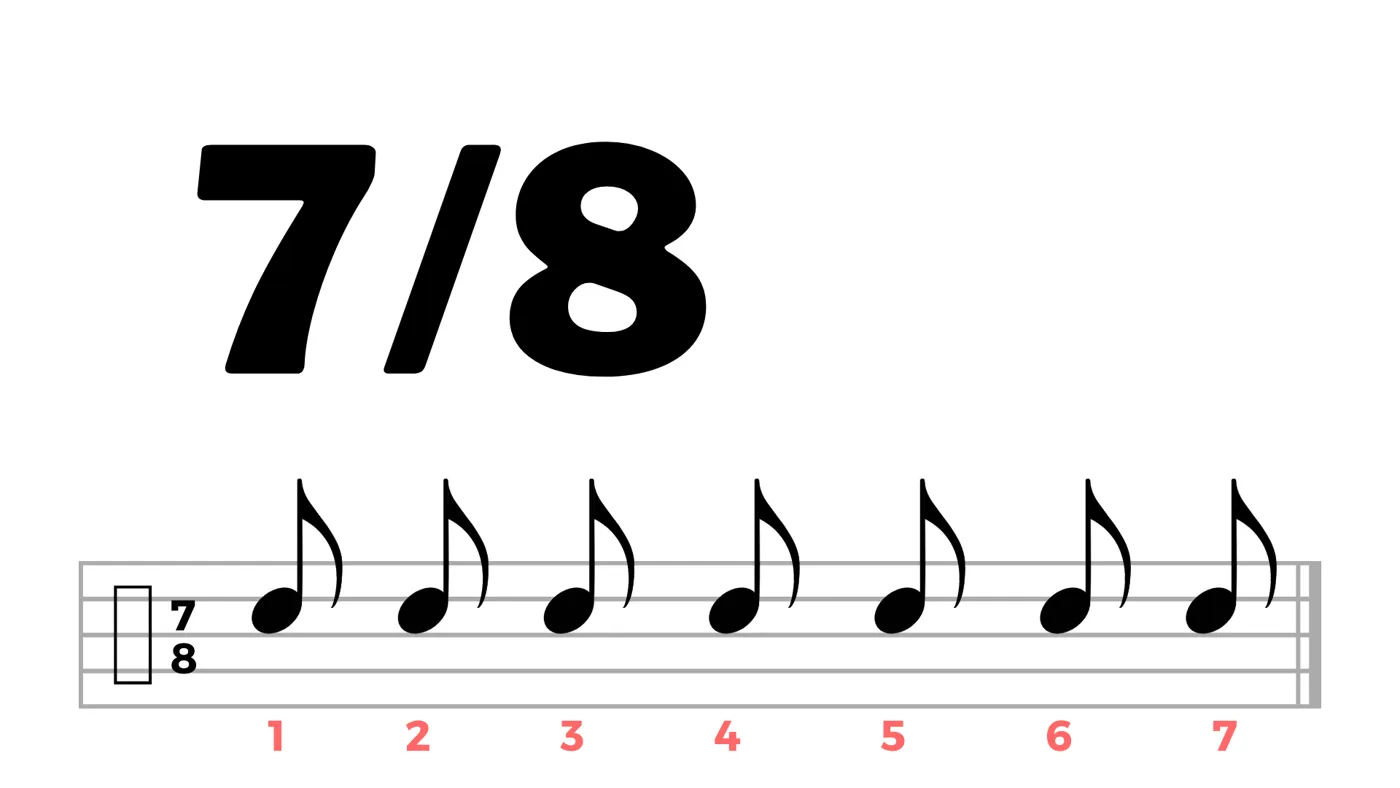
7/8 is easiest to understand by comparing it to 6/8. 6/8 has two groups of three (ONE-two-three FOUR-five-six). 7/8 has one more eighth note, so seven. The seven beats are usually split into groups that make counting easier:
- 6/8: 1 2 3 4 5 6
- 7/8: 1 2 3 4 5 6 7
- 4 + 3: ONE-two-three-four ONE-two-three
- 2 + 2 + 3: ONE-two ONE-two ONE-two-three
The grouping depends on the song. Listen to where the bass drum and snare land, and pick the way of counting that fits the music. For example, in the first groove below the bass drum lands on beats 1 and 5, so it's counted 4 + 3: ONE-two-three-four ONE-two-three.
Watch the video for more tips on playing 7/8 grooves.
Songs in 7/8
Try counting along with the song: ONE-two-three-four-five-six-seven, and again from one. Remember to count in eighth notes, so faster than you'd count ONE-two-three-four in a 4/4 song.
In this video you can see from the notation that the bar has seven beats. Hank Levy's Whiplash was actually originally written in 7/4 (partly 14/8), so there are seven beats, but they're quarter notes.
Recap
- 12/8: counted 1 & a 2 & a 3 & a 4 & a, four pulses
- 7/8: seven eighth notes, split into groups of 4 + 3 or 2 + 2 + 3
Next, you can read Time Signatures 3, where we look at songs where the time signature changes in the middle of the song.