 Tasodrums

Why it's useful to learn time signatures
The basics of drum notation aren't very complicated. A little studying gets you a long way. But of course music theory doesn't end with the basics, and this topic has plenty of rabbit holes to explore too. Today we'll look at the one that probably confuses beginners the most: time signatures.
Just understanding the basics of time signatures helps a lot. All the music you play is in some time signature. That's why the same grooves and fills don't fit every song. They literally don't fit: they have too many notes, they end too early, or their accents don't suit the song. For example, a fill counted in four won't fit in a bar that's only counted to three, and then you're in trouble.
Time signatures aren't just for drummers, of course. The same things apply to every musician. The better you understand this general music theory, the easier it is to communicate and play with others.
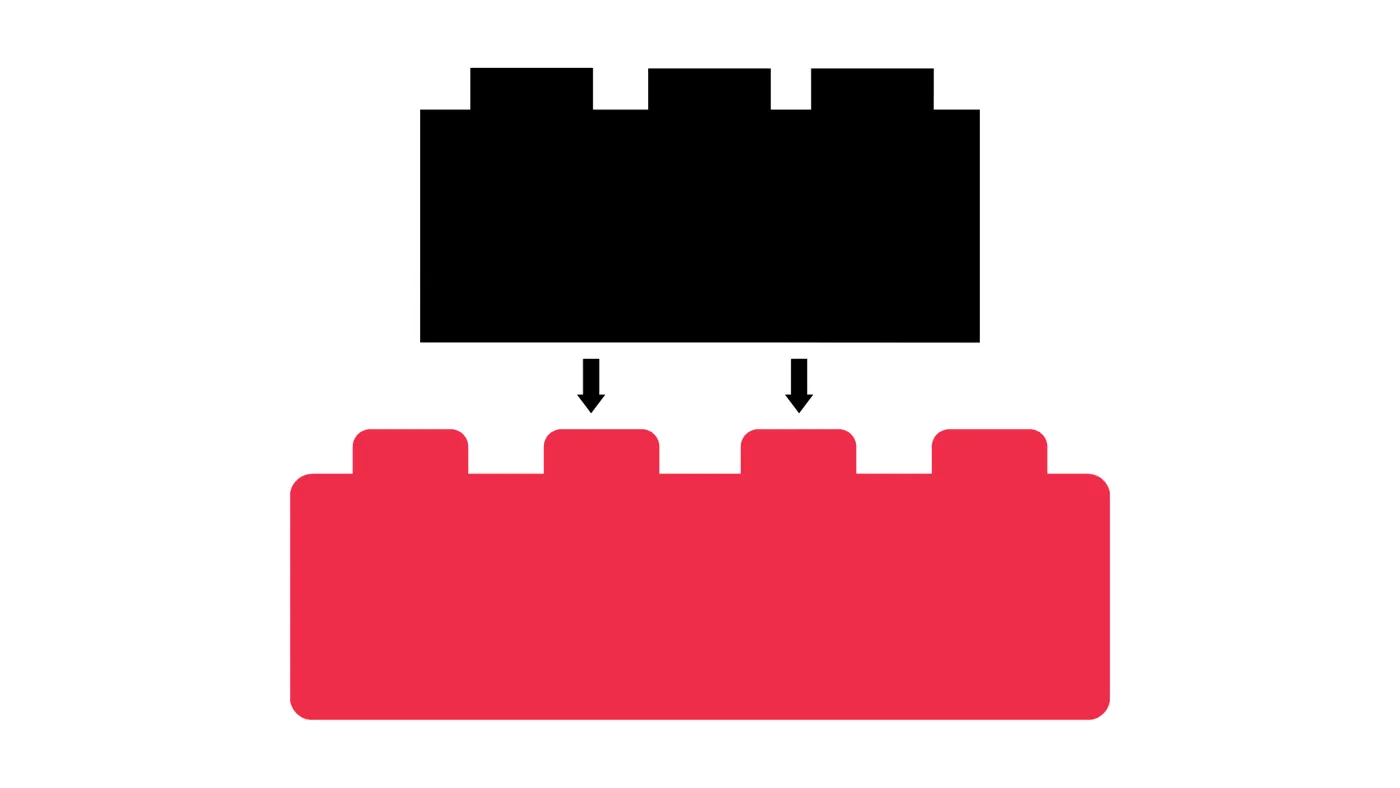
In this post you'll learn the three most common time signatures, which are closely related to each other:
- 4/4 – counted in four
- 3/4 – counted in three
- 6/8 – counted in six, but felt as two pulses
The less common 12/8 and 7/8 are covered in Time Signatures 2, and songs where the time signature changes in the middle are covered in Time Signatures 3.
Time signatures
A time signature tells you how many parts there are in one bar. A bar is the chunk that repeats: when you count "1 2 3 4, 1 2 3 4", every new one starts a new bar. The time signature helps you make sense of the basic rhythm of the music. It's written like a fraction, with two numbers stacked on top of each other. The top number tells you how many parts there are in a bar, and the bottom number tells you how long one part is.
For example, if we see the time signature 4/4, it means one bar has four parts, and each part is one quarter note long. You can think of it as four steps in one bar, with each step lasting a quarter note. So you count 1 2 3 4 and start over again.
The time signature numbers
The numbers at the beginning of a piece of notation that tell you the time signature are called the time signature. In Finnish there are actually two separate words for this: one for the meter itself and one for the written numbers. In English, "time signature" covers both.
You can simplify the time signature like this:
The top number tells you how far you count before starting over. It can be anything, but it's usually something between 2 and 16.
The bottom number tells you how fast you count, meaning which note value you count in. For example, 4 means quarter notes and 8 means eighth notes, which go twice as fast at the same tempo. The actual speed is set by the tempo (BPM). The bottom number is always one of the standard note values, because it has to be a note that everyone who plays music understands.
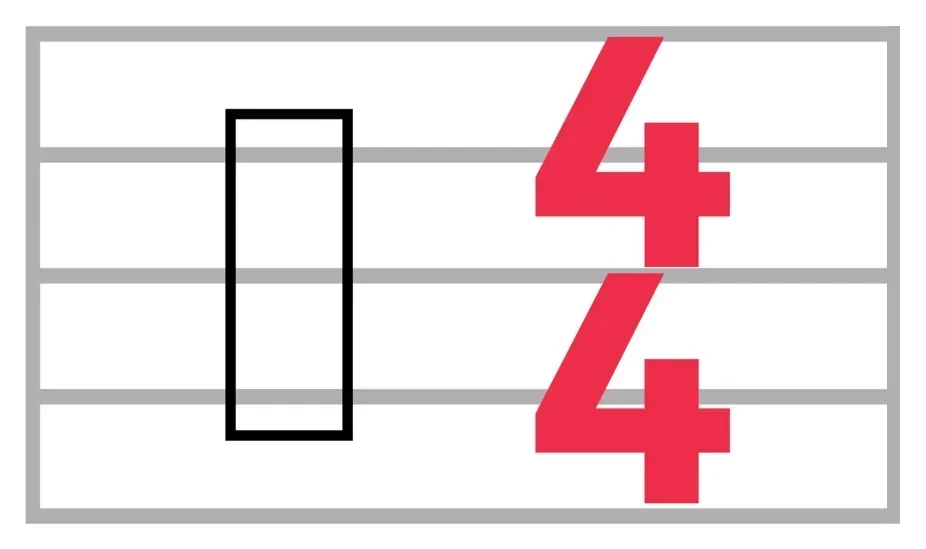
Try it yourself: Start a metronome and count out loud 1 2 3 4, 1 2 3 4. Accent the one a little harder than the others. This is exactly what the time signature tells you: how far you count before starting again from one.
4/4 - the most common time signature
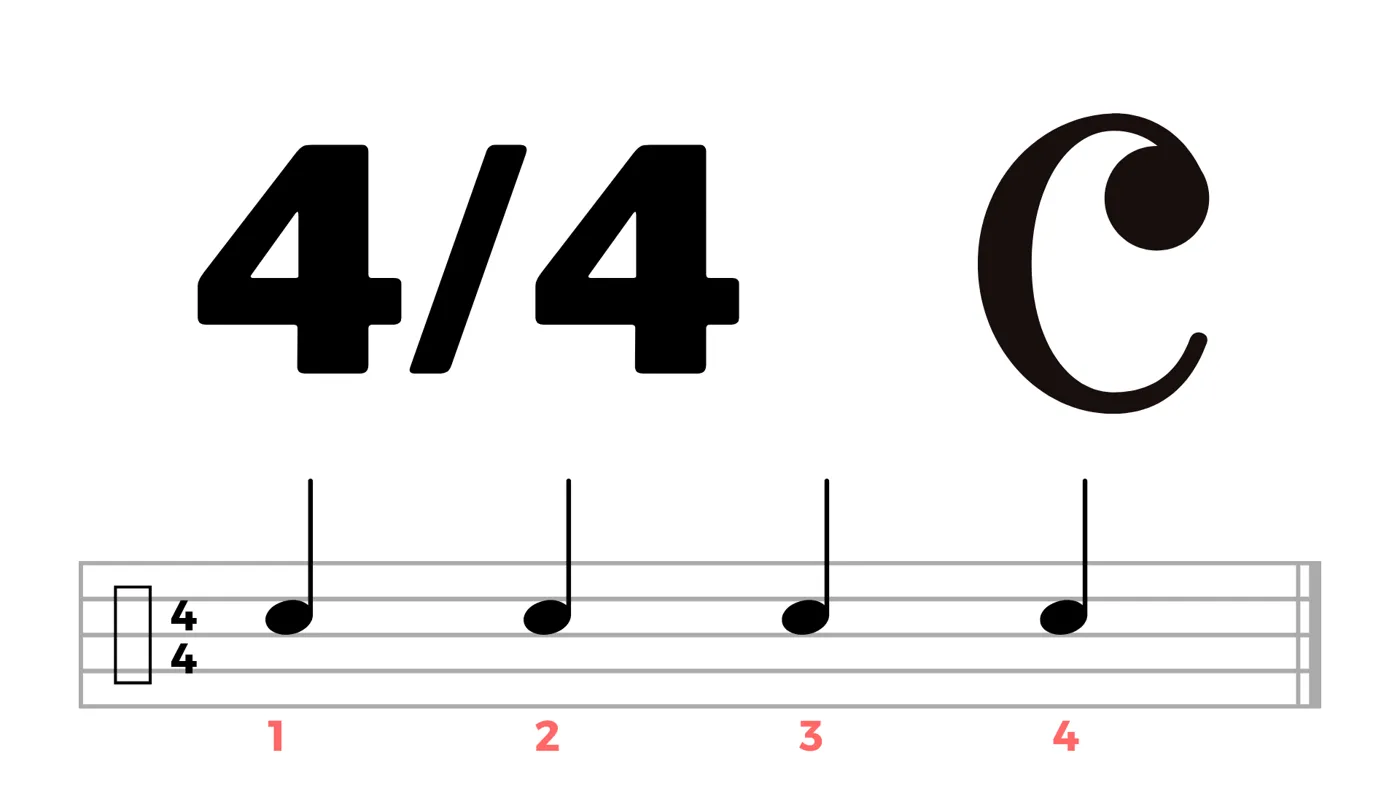
Next, let's look at the most common time signatures with examples.
4/4 is by far the most common time signature in Western music. That's why a beginner doesn't really need to know anything about time signatures to play music. We recognize this time signature without even knowing it.
Almost all pop, rock and hip hop songs are in 4/4. If you listen to the radio, most of the songs you hear are probably in 4/4.
4/4 is so common that it's also written as "common time", which is the C-shaped symbol in the picture.
In 4/4 you count to four at the speed of quarter notes. Out loud it sounds like this: ONE-two-three-four, ONE-two-three-four. If you tap your foot along to a radio song, your taps are usually exactly these quarter notes.
- 1 – ONE (the strongest beat of the bar)
- 2 – TWO
- 3 – THREE
- 4 – FOUR
The first beat of the bar, the one, is usually the strongest point in the bar. In a song, the bass drum often lands on the one, and at the start of a section, so does a crash cymbal. When you listen to a song, try to find the one first. After that, the rest of the beats are easy to find.
As you'll notice in the examples below, the time signature doesn't mean a bar can only contain that one note value. Our music would be pretty monotonous if that were the case. In the first example the hi-hat plays quarter notes, but in the second it already plays denser sixteenth and eighth notes. That's why you need a little math and an understanding of notes: you have to know how many of each note fit in one bar. For example, a 4/4 bar fits four quarter notes or eight eighth notes. There's more about this in the previous post.
Songs in 4/4
Next, let's look at two songs in 4/4 time. Try to find the steady tempo, or pulse, in the song: the thing your foot starts tapping to on its own. Tap along and count ONE-two-three-four. These taps are written as quarter notes in notation. If this feels hard, review the earlier blog post on notation here.
Other songs in this time signature:
- Sweet Home Alabama - Lynyrd Skynyrd
- Wonderwall - Oasis
- Believer - Imagine Dragons
- Blinding Lights - The Weeknd
In this song you can follow the 4/4 time from the bass drum and snare notes. The bass drum is on beats 1 and 3, and the snare on beats 2 and 4. When you count along ONE-two-three-four, the bass drum lands on ONE and THREE, and the snare on TWO and FOUR.
In this song the hi-hat plays quarter notes before the groove starts, so you can hear the tempo from it. This is often why a drummer clicks the sticks together at the start of a song. They're "counting the band in" with quarter notes.
3/4
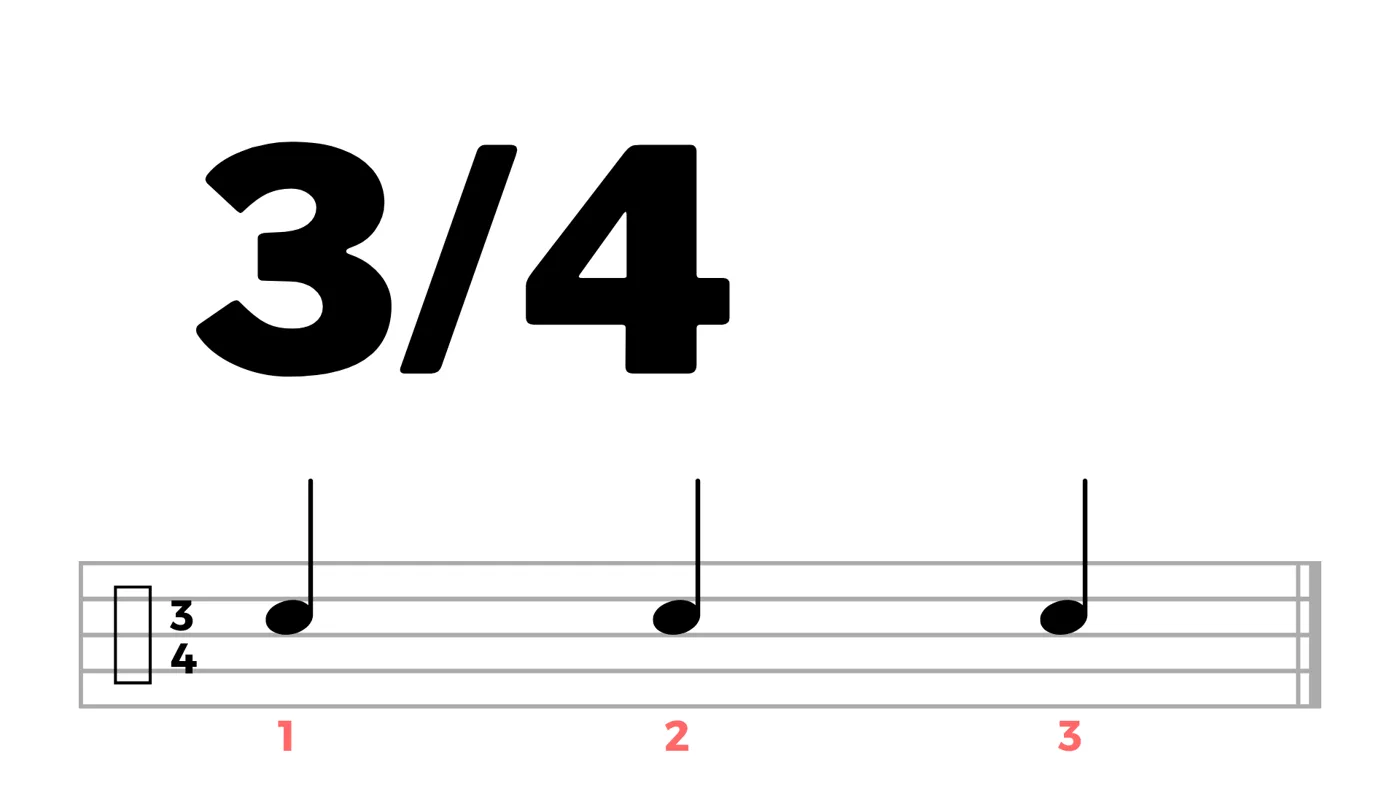
3/4 is also a fairly common time signature. It's different from, for example, 2/2 and 4/4. Those have an even number of beats per bar, and the beats naturally split into groups of two. That makes the time signature duple.
In 3/4, on the other hand, the beats feel like groups of three (ONE-two-three), so the time signature is triple.
- 4/4: ONE-two-three-four → duple
- 3/4: ONE-two-three → triple
In 3/4 you count to three at the speed of quarter notes. So the speed is the same as in 4/4, but the four is dropped: ONE-two-three, ONE-two-three. The most common example of this time signature is the waltz.
The examples below have the same grooves as the 4/4 section, but now in 3/4. It's good to notice here that what you play doesn't necessarily change when the time signature changes. The pattern just loses its last beat, and it starts over after the three instead of after the four.
Think of it like this: you're driving home from the store, and someone has moved the STOP sign one intersection earlier. You don't suddenly forget how to drive a car or ride a bike. You just stop earlier.
Below is a typical waltz groove. The bass drum plays the one, and the snare plays beats 2 and 3. Count along: ONE-two-three, ONE-two-three.
Watch the video for more simple 3/4 grooves on the drum kit.
Songs in 3/4
As the name says, this song is a waltz. First listen to the beginning of the song before the drums, and then to the part where the drums come in. The drums clearly make it easier to find the rhythm. Try counting ONE-two-three in both parts.
In this song you can clearly hear three separate pulses. Count along ONE-two-three, ONE-two-three.
6/8
In 6/8 time things start to change a bit. The bar is no longer counted in quarter notes but in eighth notes. At the same tempo, eighth notes go twice as fast as quarter notes. In notation, the flags of eighth notes can also be joined with a beam, a horizontal line. It looks different, but it doesn't change the time signature or the notes.
So in this bar you count to six, at the speed of eighth notes.
6/8 is counted to six: ONE-two-three FOUR-five-six. The accents fall on beats 1 and 4, so the bar splits into two groups of three beats. That's why 6/8 often feels swaying, a bit like two groups of three in a row.
- ONE-two-three
- FOUR-five-six
This time signature is very common, so you've definitely already heard plenty of songs in it. There are example songs further down.
6/8 is a typical time signature for ballads and slow love songs. Its swaying, two-pulse rhythm suits slow songs that need both mood and movement. A good example is Metallica's Nothing Else Matters, which is written in 6/8.
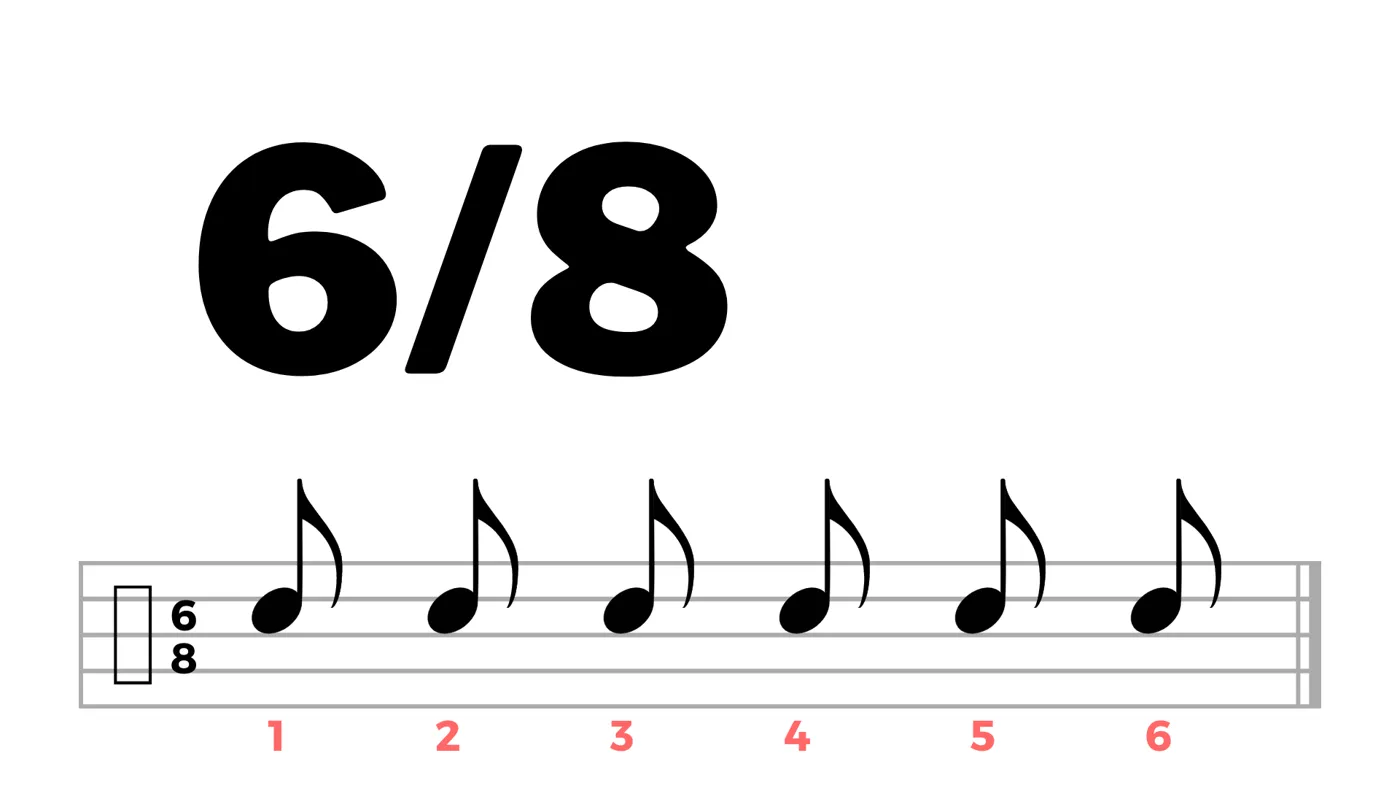
Now we can't use quite the same grooves as in 4/4 and 3/4, because the rhythm of this time signature is different. What's typical of 6/8 is that you usually feel two separate pulses, on beats 1 and 4. In the examples below, the bass drum starts on the one and the snare plays the four, which are exactly those two pulses.
In the example below, the hi-hat only plays beats 1 and 4. This way you can clearly hear how a 6/8 bar splits into two pulses.
Watch the video to see how 6/8 grooves are played on the drum kit.
Songs in 6/8
Other songs in 6/8:
- The House of the Rising Sun - The Animals
Metallica's Nothing Else Matters is written in 6/8. Listen to the iconic guitar intro at the start of the song and count along: ONE-two-three FOUR-five-six.
JVKE's golden hour is written in 6/8. Count along ONE-two-three FOUR-five-six: you'll feel how the song sways in two pulses.
Here you can easily hear how the hi-hat plays six eighth notes per bar, the bass drum plays beat 1 and the snare plays beat 4. When you count ONE-two-three FOUR-five-six, the bass drum lands on ONE and the snare on FOUR.
Pro tip: what's the difference between 3/4 and 6/8?
Mathematically these time signatures are identical: three quarter notes last just as long as six eighth notes. That's why it's sometimes really hard to tell which one it is. Especially if all you have is the notation, without the song or other instruments that could help you figure out the time signature.
There is one way of thinking about it that makes it a bit easier, though:
3/4 has a steady three-beat pulse (ONE-two-three), no matter what else is going on in the groove.
In 6/8, on the other hand, the rhythm often has two pulses, one on beat 1 and another on beat 4 (ONE-two-three FOUR-five-six).
In both examples below, the hi-hat plays six eighth notes. The difference is in the snare: in the 3/4 groove it plays beats 2 and 3, in the 6/8 groove only beat 4.
- 3/4: 1 & 2 & 3 & → three pulses
- 6/8: 1 2 3 4 5 6 → two pulses (1 and 4)
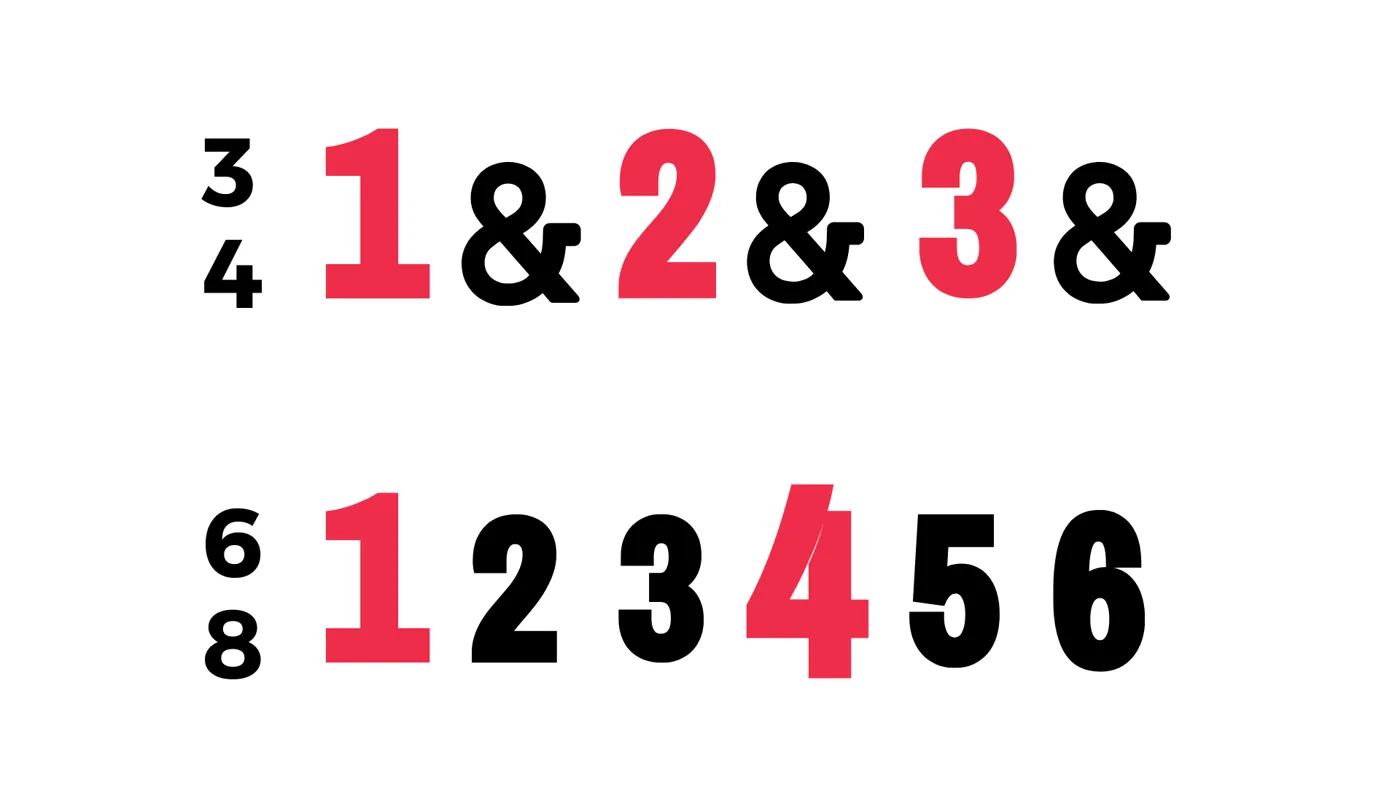
Here's one more video explaining the differences between 3/4 and 6/8.
For example, JVKE's golden hour from the 6/8 songs above is written in 6/8 in the official sheet music, but some arrangements use 3/4.
Recap
- 4/4: counted in four, the most common time signature in pop and rock
- 3/4: counted in three, for example the waltz
- 6/8: counted in six, accents on beats 1 and 4
Once you've got these three down, you can already recognize most of the music you hear. Next, you can move on to Time Signatures 2, where we go through 12/8 and 7/8.