 Tasodrums

Does a drummer need to know how to read music? What good is notation to a drummer?
Drums are pretty different from other instruments in this respect. For example, piano or guitar players often start by learning notes, chord shapes and tabs. Playing by ear and practicing improvisation only start once the basics are solid and your ear has developed.
With drums, you can also start the other way around. Simple things are fairly easy to pick up by watching an example or a video. As your skills grow, you can also learn songs by ear and by watching other drummers' videos.
But drumming and music are also like any other language. It's not very useful to be able to listen and speak if you can't read or write. On the drums, what we mainly do is play different rhythms with different limbs at the same time, for example the hi-hat with a hand and the bass drum with a foot. Even the basics of notation help you combine these rhythms more easily. That's why it's worth adding notation to your practice pretty early on.
The basic concepts
The most important thing to understand is that drum notation looks different from, say, piano music, but the concepts in this post are the same for every instrument. Once you learn how these basic notes fit into a song you already know, you'll understand music a lot better.
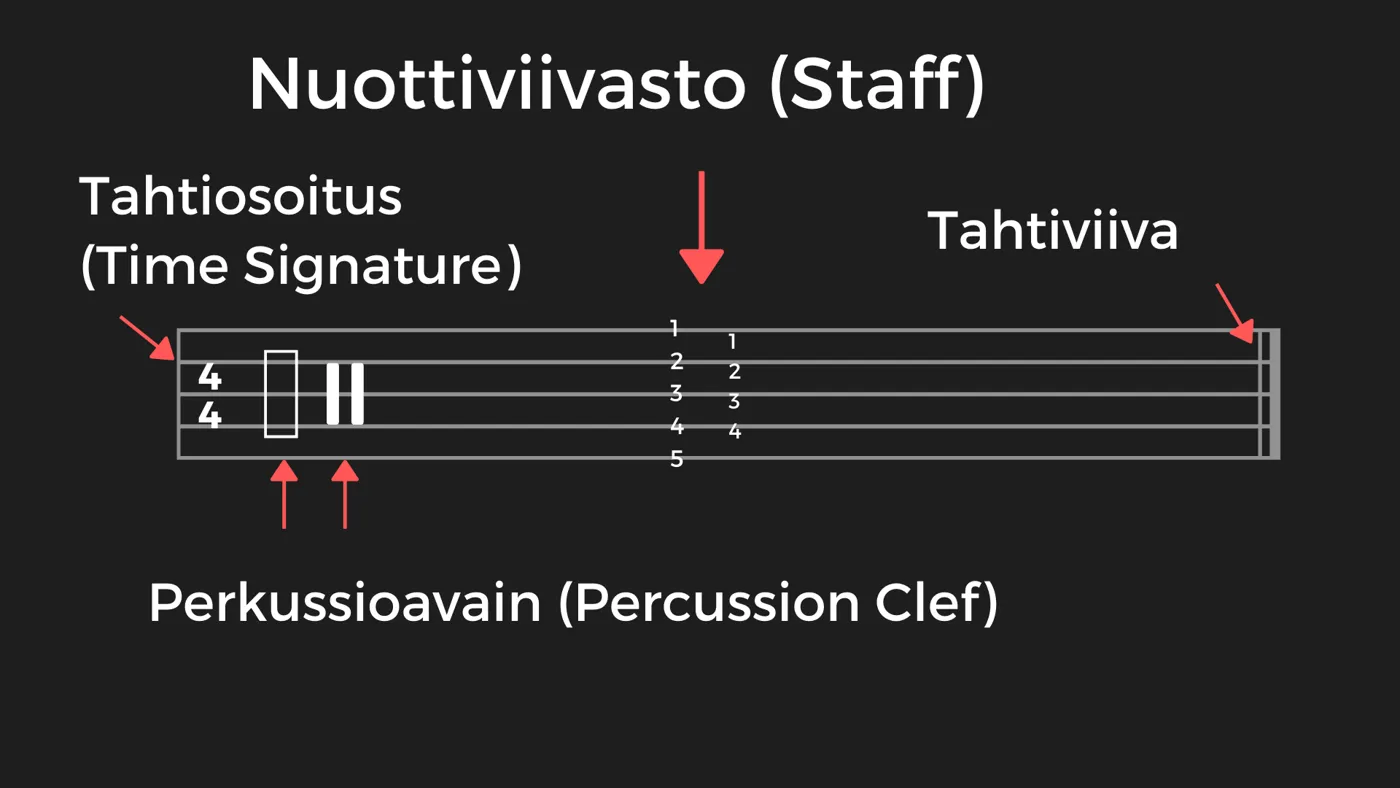
The staff, where the notes are written. The staff has five lines and four spaces. When needed, ledger lines can be drawn above or below the staff.
The percussion clef. The picture shows two different ways to mark that the music is for percussion.
The bar (measure). A song is made up of bars one after another. Each bar holds a certain number of notes of a certain length. We'll come back to these rules soon in the time signature section.
The bar line, which separates the bars from each other and makes the music easier to read.
The time signature, where the top number tells you how many beats there are in a bar and the bottom number tells you how long one beat is. For example, in 4/4 time every bar has four beats, and each of them is one quarter note long.
= The top number tells you how far you count, and the bottom number tells you how fast you count.
A good rule of thumb is that the top number can be pretty much anything. You count up to it and start over. For example, in 3/4 time you count "one two three, one two three". Numbers from 2 to 16 are commonly used.
The bottom number is trickier. It tells you how fast you count, meaning which note value you count in. Let's say you count to four (one two three four). You can count it in quarter notes or in eighth notes, for example. At the same tempo, counting in eighth notes is twice as fast as counting in quarter notes. Since the speed has to be something another musician understands too, the bottom number has to be an actual note value: 1, 2, 4, 8, 16, 32 or 64.
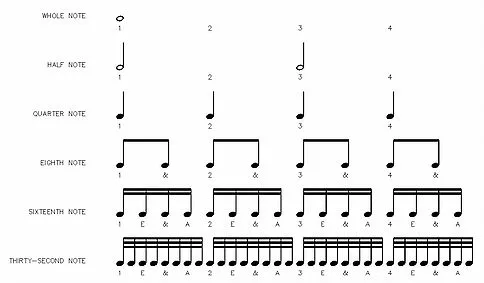
Notes: What are the standard note values
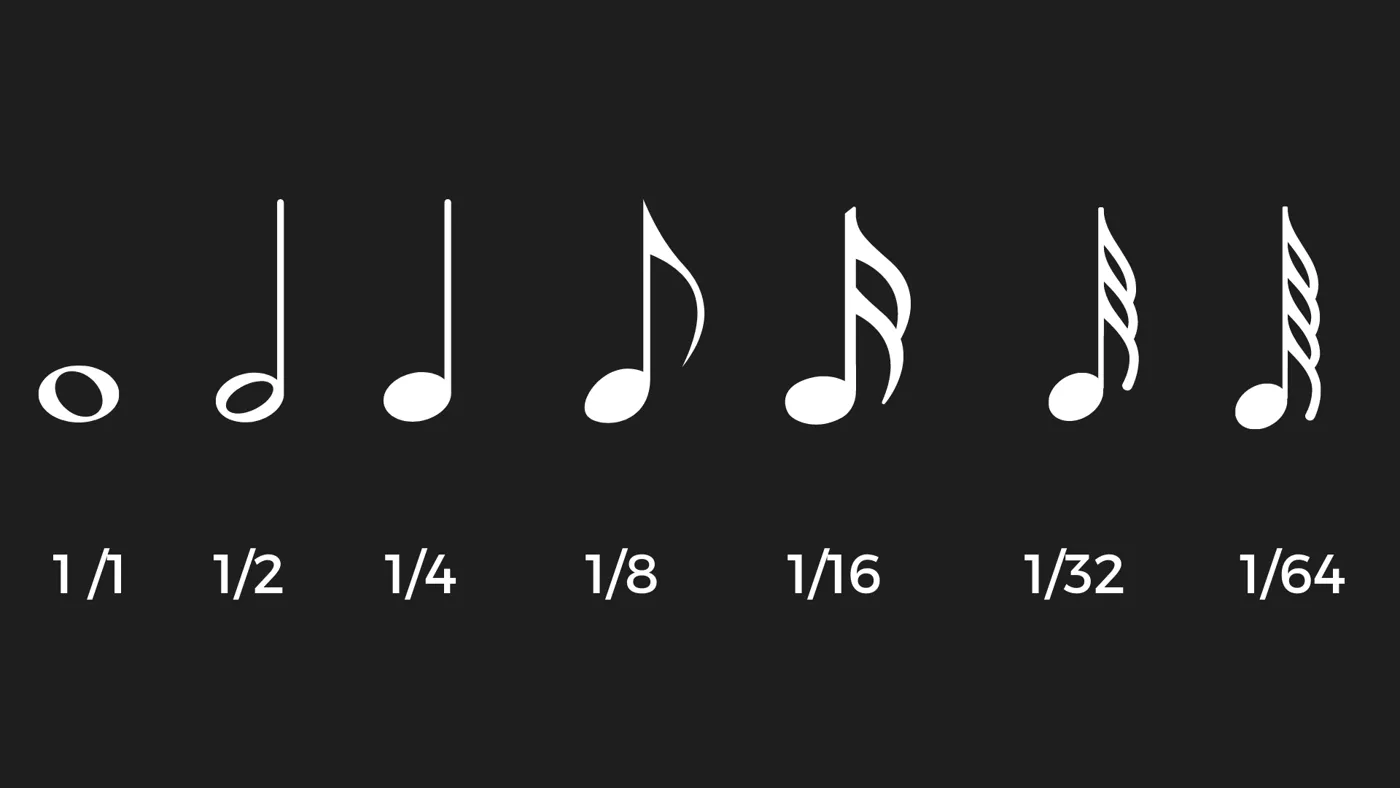
The standard note values are:
- Whole note 1/1
- Half note 1/2
- Quarter note 1/4
- Eighth note 1/8
- Sixteenth note 1/16
- Thirty-second note 1/32
- sixty-fourth note 1/64 (which you rarely see in drum music)
The parts of a note are the head, the stem and the flag. Whole and half notes have an empty (open) head, and all other notes have a filled-in black head. Every note except the whole note also has a stem. Some notes have one or more flags, which make them easier to tell apart: for example, an eighth note has one flag and a sixteenth note has two. When several notes are written in a row, the flags are joined into horizontal lines (beams).
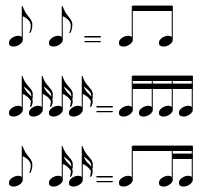
When you go from a bigger note to the next smaller one, the length of the note is cut in half. That means twice as many notes fit into the same space. For example, two quarter notes fit in place of one half note.
The lengths of notes are called note values. This would be easy to explain with a keyboard: when you hold a key down for a long time, you get a long sound, and a short press gives you a short sound.
With a drum, though, you can't get a longer or shorter sound by hitting it differently (well, a little, but not enough to make it a different note). That's why with drum notation it's easier to think of a note's length as how long it takes before you play the next stroke.
Learn to recognize the quarter note
The tempo of music is marked as BPM - beats per minute. Since one minute is 60 seconds, 60 BPM means one beat per second. In the same way, 120 BPM is two beats per second.
The quarter note is the most important note for a drummer to learn to recognize as soon as possible. The quarter note equals the song's tempo / pulse. When you listen to music and your head starts nodding or your foot starts tapping a steady rhythm, that's most likely the pulse of the song. People have a natural ability to pick up the pulse.
In the example below, the first thing you see on the left is a rectangle, which is the percussion clef. This means the music is for drums/percussion.
Next you see the 4/4 time signature, which means that in this bar you count to four (top number) at the speed of quarter notes (bottom number). So you count "one two three four", and each number is one quarter note.
Listen to the example by pressing the gray arrow. You'll hear four even beats, and each of them is one quarter note.
Let's look at and listen to a couple of examples
In the example below, the first bar has quarter notes (the pulse I mentioned in the previous section) and the second bar has eighth notes. So the second bar has twice as many beats. As you can see when you compare these bars, you can tell the notes apart not only by speed but also by how they look: the eighth notes are joined together with a horizontal line.
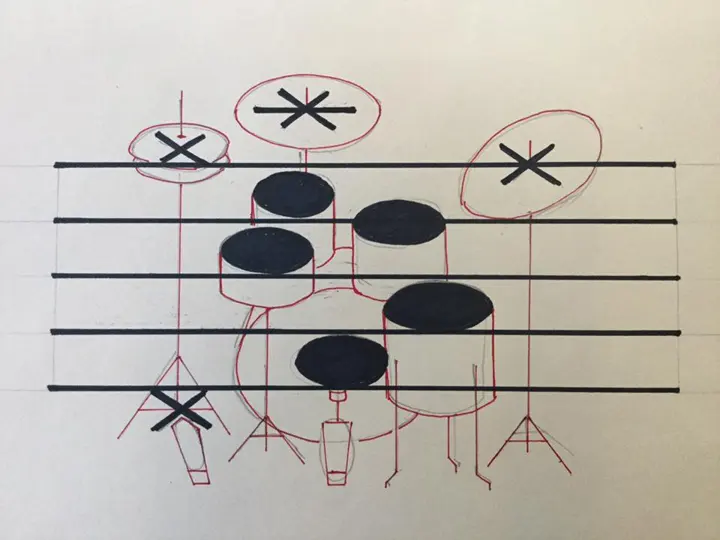
P.S. A cross (x) in a certain spot on the staff means the hi-hat cymbal. We'll talk more about drum notation in the next post.
In the next example, the first bar is sixteenth notes and the second bar is 32nd notes.
As you can see, the notes get cut in half every time you move to a smaller note. That's why more of them fit into one bar: 16 sixteenth notes fit into a bar of 4/4, and 32 thirty-second notes. The notes also look different again. A sixteenth note has two flags, or horizontal lines, and a 32nd note has three. This way you can quickly see which note it is.
Counting notes helps you learn and play
A drummer's most important job is to keep the rest of the band in time. That's why a drummer has to know time really well, meaning know exactly when each beat lands.
Knowing time basically means playing the different notes at the right moment. This is where counting notes helps us. Counting and clapping notes helps a lot, so it's worth getting good at it.
How do you count notes?
You can count notes either in your own native language or in English, but I recommend switching to counting in English as soon as possible. The reason is that almost all the free learning material out there is on YouTube, and almost without exception it's in English. When you learn to count in the same language as the lesson video, it's easier to follow along and learn.
If this feels confusing at this point, check out the video below. The examples start at about the one-minute mark.
The video is about piano music, but like I said at the beginning, this theory part is the same for every instrument.
Practice reading and counting notes with a rhythm pyramid
In the notation below, the notes get faster every two bars: first quarter notes, then eighth notes and finally sixteenth notes. Listen and count along. You can also see how to count it above the bars.
Bars 1 and 2 / quarter notes = ONE TWO THREE FOUR
Bars 3 and 4 / eighth notes = ONE AND TWO AND THREE AND FOUR AND
Bars 5 and 6 / sixteenth notes= ONE e and a TWO e and a THREE e and a FOUR e and a
32nd notes = the same counting as with sixteenth notes, but you play two strokes on every syllable.
I hope this post helped you get started with learning to read music. The goal was for you to understand the basic concepts of notation and a bit about how notes work. The next post digs into drum notation, so it's fine if this didn't fully click yet. We'll pick up from here in the next post!