 Tasodrums

Drum notation
In this post we learn our first drum notes and how they're written. One reminder right at the start: drum notation varies a little, especially for cymbals. For example, the ride may be written in a different spot depending on who wrote the music. Keep this in mind when you read music from different writers.
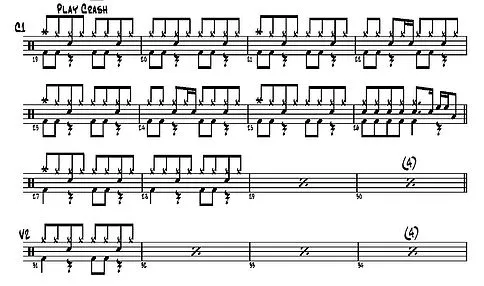
Drum music is written in two styles: precise notation and notation that supports improvisation. Both styles have their own standards and requirements.
A drummer doesn't always get any drum music at all. They might get the vocal or piano part, for example, and use it to come up with drum parts that fit the song as best they can. That's why understanding notation matters: even in this situation you can make better choices than you could without any knowledge of music or drum notation theory.
1. Exact, detailed notation (Precise)
As the name suggests, in precise notation everything is written out exactly, and you're also supposed to follow it just as exactly: you play exactly the strokes that are written. Check out the video below for an example.
2. Notation that supports improvisation (Improvisational)
Improvisational notation is more of a framework or a "cheat sheet". It might show the parts that matter for the flow of the song, but the details are left out. The drummer gets to decide how best to play them.
The chart might say something like "hi-hat open, 4 bars. Build it up", or it might have some of the lyrics written out with a certain groove marked next to them, so the drummer can check which groove to play during the verse, for example.
Drum notation symbols
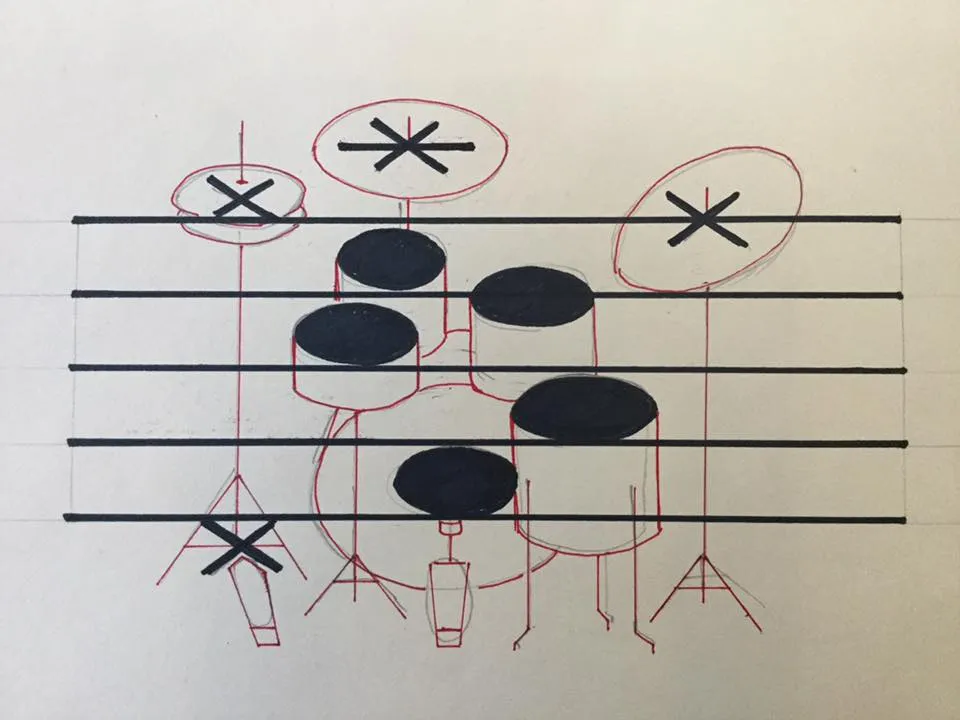
The most important thing to understand about drum notation at the start is that each line or space has a specific drum.
For example, the snare is in the second space from the top of the staff, and the bass drum is in the bottom space.
Cymbals are usually marked with an x, and other percussion instruments, like cowbell, with different triangles. The snare, toms and bass drum, on the other hand, are marked with a round note head. Once you remember these, you're already well on your way. Take another look at this post's cover image, where you can see them pretty clearly.
Kick = Bass drum
Snare (with a cross-stick you play on the snare's hoop, more on this later)
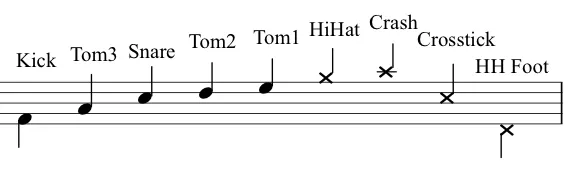
Bass drum. If you're using a double pedal, the second pedal is usually written on the bottom line of the staff.
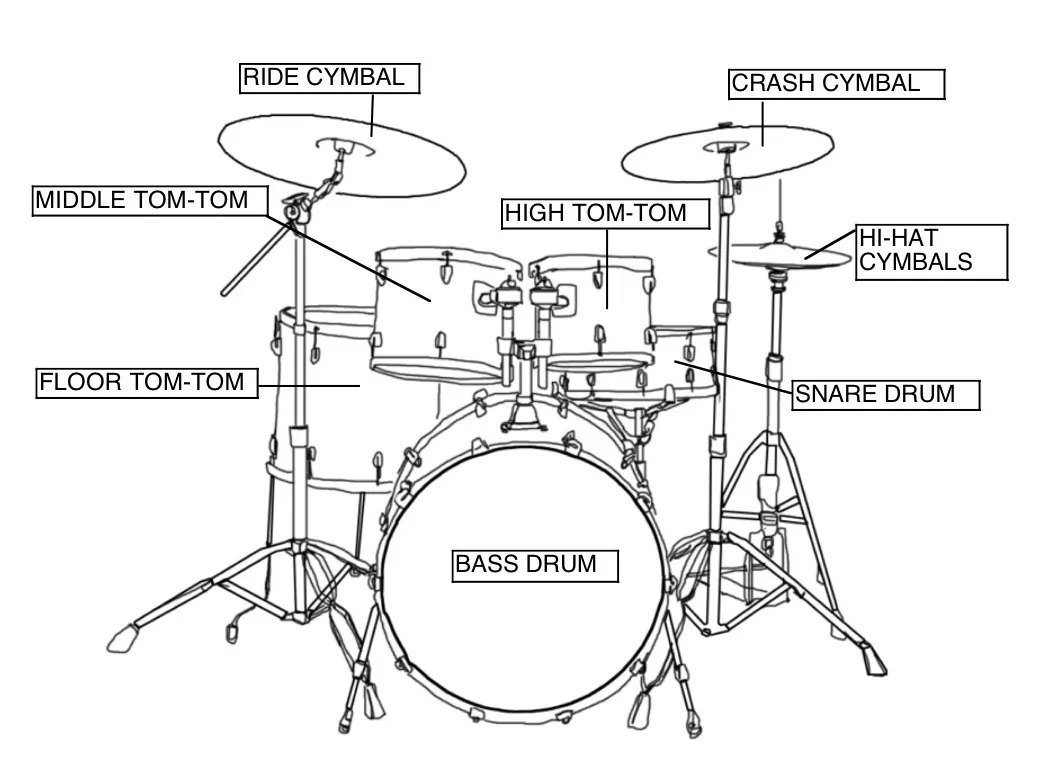
Toms: The rack toms, or tom-toms (high tom and mid tom). In Finnish we don't use separate names for them. Where the toms go on the staff depends on how many toms there are, but this is the most common way to write them.
Hi-hat open: An open hi-hat is marked by circling the x or by adding a small circle above it.
Ride cymbal: In this picture the ride is written in the same spot as the hi-hat, but another common way to write the ride is to move the note up onto a ledger line, like the crash.
Watch a video about drum notation
Let's learn your first drum grooves
1/4 groove = quarter-note groove
Check out the example below to see how to play a quarter-note beat. The drums used are the hi-hat, snare and bass drum. The hi-hat plays on every count, the bass drum on counts 1 and 3 and the snare on counts 2 and 4. While playing the groove you can count 1 2 3 4, like we learned in the previous post.
The > sign you see on some of the notes means an accent, which is a stronger stroke. You can ignore it for now.
1/8 groove = eighth-note groove
Next, let's move on to the eighth-note beat
As you can see, the bass drum and snare still play in exactly the same spots: the bass drum on beats 1 and 3 and the snare on beats 2 and 4.
The difference from the previous groove is in the hi-hat. It plays twice as many notes, and each note is half as long. So the hi-hat plays on every count and also between the counts.
Count this groove: One and two and three and four and. Each syllable is one hi-hat stroke.
1/16 groove = sixteenth-note groove
The third common drum groove is the sixteenth-note beat. The bass drum and snare are still in the same spots as before, but the hi-hat plays smaller notes again: four strokes for every count.
Count this exercise: One e and a Two e and a Three e and a Four e and a. Again, each syllable is one hi-hat stroke.
Quick question: How fast should you play?
How do you know how fast each groove should be played? The same groove sounds very different played slow and fast. You can't know how long the notes are unless the tempo is given.
A recap from the last post: Tempo is marked in BPM, which means beats per minute. The more beats per minute, the faster the tempo. Below is the same groove, first at 60 BPM and then at 100 BPM. The order of the notes and the way you count don't change, only the playing speed does. Click the arrows in the playback example to change the tempo however you like!
60 BPM
100 BPM
Check these as you play:
- What tempo you're playing in
- Which notes you should play (note values: quarters, eighths, sixteenths, etc.)
- Which drum you're supposed to hit
Download a free metronome app from your phone's app store so you can practice playing at different tempos. Your sense of tempo is still a drummer's most important skill, so metronome practice is the key to succeeding as a drummer. There are lots of different apps, so you can download a few and find the one that suits you best.
Let's learn your first drum fills
The rhythm patterns you play between grooves are called fills (fill-ins). Fills are used to spice up a song, to tell the band and the audience that the song is moving on to the next part (for example from the verse to the chorus), and to add more texture to your playing.
1/4 groove with a one-bar fill (also 1/4)
1/8 groove with a one-bar fill (also 1/8)
Fills with sixteenth notes too
Finally, a couple more fills that use quarter, eighth and sixteenth notes.
I hope this post helped you get started with learning drum notation. There's still a lot of theory these two posts didn't cover, but once you learn the basics, you can keep learning on your own, in online drum lessons or in private drum lessons.
Check out the "Beginner drumtracks" playlist on Spotify for songs that work well for beginners.