 Tasodrums

Learn to read music
1: Read the blog
Put simply, playing from sheet music comes down to three things:
- What the tempo is (how fast you need to play)
- Which drums you play
- Which notes you play on each part of the kit
Once you know all of these - what speed, which drums and which notes - that's basically it. I know, it doesn't feel that easy at first, but look:
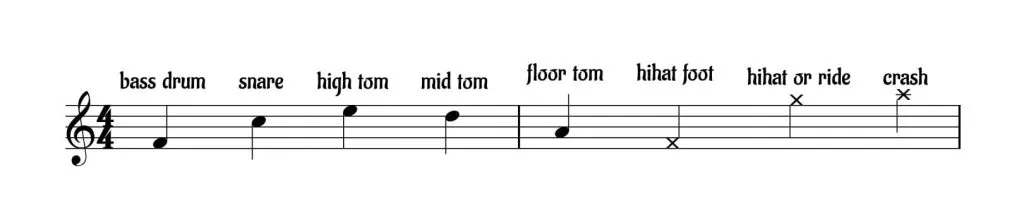
Read the short theory part in the first notation post, or go further if you like! The most important thing is that you understand what tempo is and what a quarter note is. In the second post (drum notation), check where the snare, bass drum and hi-hat go on the staff.
You'll find all the notation posts in order on the blog page!
2: Find the tempo
Listen to the song. Where does your foot or hand start tapping a steady beat? That's the tempo!
Once you find the pulse, try counting along with it out loud: ONE TWO THREE FOUR, and back to the start. If the count lands in the right spots and feels natural, you've found the song's quarter notes. There's more about this in the first notation post.
You can find a song's exact tempo on a site like songbpm.com, or with the tap tempo feature in a metronome app: tap the screen along with the pulse and the app tells you the BPM. Most pop and rock songs are somewhere between 80 and 130 BPM.
3: Snare and bass drum
Listen to this song. Where do you hear the bass drum, and where do you hear the snare? The bass drum is a low "boom" and the snare is a sharp "crack". In a basic groove they take turns as you count to four:
1 - bass drum
2 - snare
3 - bass drum
4- snare
And when you add a little more on top, it already starts to sound pretty cool!
4: The groove
Add your right hand on the hi-hat and play along with the song! In the first example below, the hi-hat plays quarter notes, and the second bar has a short fill on the toms. In the second example, the hi-hat plays eighth notes.
5: Pick your first songs
Not all songs are equally good for practice. At the start, look for songs with as few surprises as possible. A good first practice song:
- is in 4/4 time (read more about time signatures)
- is slow or mid-tempo, around 70–110 BPM
- repeats the same groove for a long time, without big changes
- is one you like listening to, because you'll hear it many times!
You'll find ready-made song lists in the Spotify playlists further down. Once the basic groove feels comfortable, you can move on to faster and more varied songs.
6: Play along with the song step by step
Once you've picked a song, don't jump straight into playing the whole thing. Go step by step:
- Listen to the song once, focusing only on the drums. Where do you hear the bass drum, and where the snare?
- Count the pulse out loud along with the song (ONE TWO THREE FOUR).
- Clap the snare hits on 2 and 4 with your hands and tap the bass drum hits on 1 and 3 with your foot.
- Play the basic groove on the drums through the whole song. You can leave out the fills and other fancy stuff for now!
- Add details only once the groove stays steady through the whole song.
If the song feels too fast, slow it down. On YouTube you can change the speed in the settings (for example 0.75x), and many practice apps let you slow down the tempo without changing the pitch. Playing it slow and right is always better than fast and wrong!
The most common pitfalls
- The tempo runs away. When you get excited, the tempo speeds up without you noticing. Keep listening to the song the whole time, not just to your own playing. Also practice with a metronome.
- Too hard a song too soon. If every bar feels like a battle, pick an easier song. Small wins keep you motivated.
- Fills before the groove. Keeping the groove steady is a drummer's most important job. The fills will come later.
- Playing too loud. You can't hear the music if the drums drown out everything. Use headphones or hearing protection and keep the music at a good volume.
When you want to play a specific song more accurately, check out the post Where to Find Drum Sheet Music for Songs. And if notation still feels unfamiliar, the Drum Notation Basics e-book has all the basics of notation in one package.
Practice writing drum notation
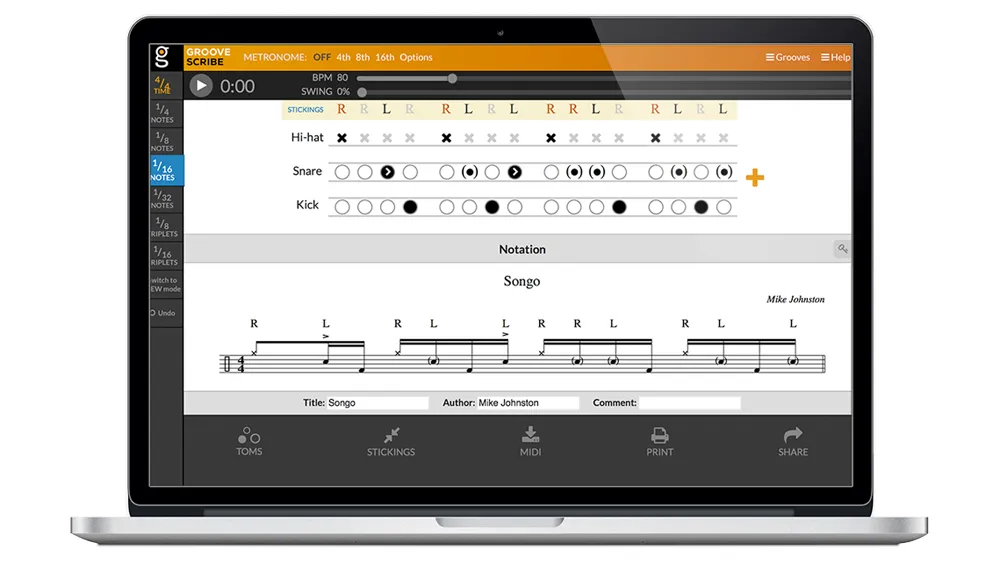
The best way to learn to read music is to practice. Groovescribe is a free browser app that makes it easy to practice reading music.