 Tasodrums

How do you know what the right time is?
Before we can talk about how a drummer can practice time and what tools help with it, we first need to figure out how you even know what time you're looking for.
The beat / pulse of music
Music usually has a beat you can sense, also called the pulse. It shows up in different ways in different styles. In dance music the beat is usually clear, in art music it's often more subtle. The beat sets the tempo of a song, meaning how slow or fast it's played.
You can compare a song's pulse to your heartbeat, which is measured with the same term: BPM = Beats Per Minute.
Once you know the tempo of a song, the drummer and the other players can start timing their notes to that tempo, and this timing is what time practice is all about. The better a drummer lines up their notes with the beat of the song, the nicer their playing is to listen to and the easier they are for the other players to follow.
How do you recognize the beat of a song?
The beat of music is usually written as quarter notes. The most common time signature in Western music is 4 / 4, which has four quarter notes per bar (bar / measure). If this sounds unfamiliar, I recommend reading the post "Learn to Read Drum Notation 1: The Basics", where I explain this in more detail.
In dance music the beat is usually fairly easy to find. People have a natural ability to recognize a pulse.
If you've ever caught yourself tapping your foot on the floor or your finger on the edge of a table while listening to music, the steady rhythm you're tapping is most often the quarter note. This is the starting point for time exercises: the pulse of the song.
Let's take Måneskin's song I wanna be your slave as an example. The Songbpm site says the song's tempo is 133 BPM. This site is a good resource for drummers, because you can check the tempo of songs there.
Side note: tempo is used in sports too. A runner can make a playlist of songs in a certain tempo for their workout and time their steps to the pulse, the same way a musician times their notes.
Listen to an example from the song with the pulse added on top of the music. (Click track)
Can the pulse change in the middle of a song?
A song's time signature, meaning how the pulse is divided into bars, can change as often as every bar. This isn't common, but there are bands whose trademark is constantly changing the time signature, which easily confuses a lot of listeners. One of these bands is Dream Theater. In the video below you'll hear time signature changes within the first 10 seconds.
Watch an example from a Dream Theater song.
Since this post is meant for beginners, we'll focus on traditional "common" time this time, meaning the 4/4 time signature mentioned above. So we count to four, at the speed of quarter notes.
The metronome is a drummer's best friend
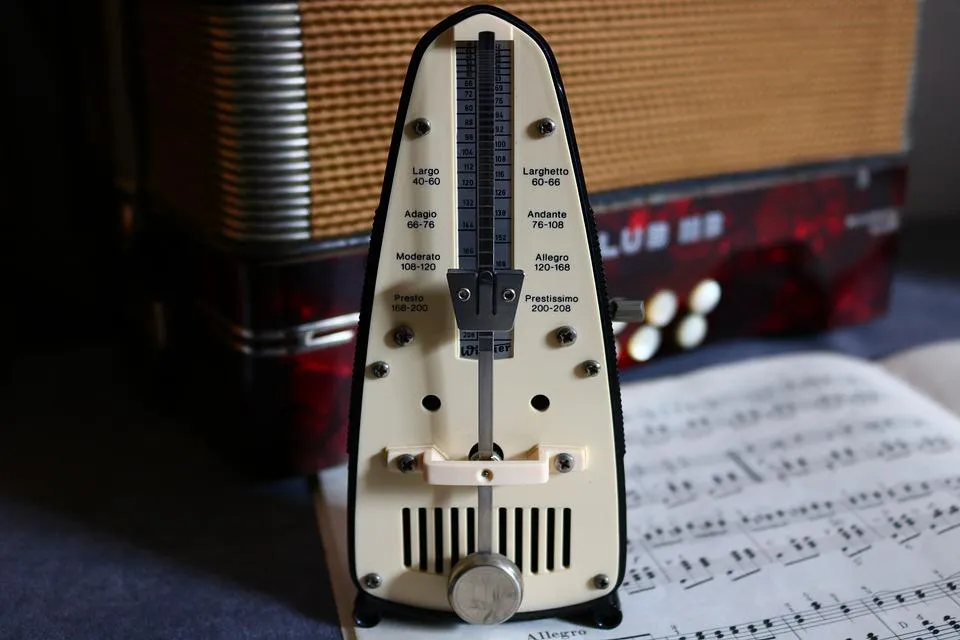
A metronome is an electronic or mechanical tool used when playing music. It ticks, clicks or gives some other sound or light signal at a set tempo. Its purpose is to help the player stay at the right tempo.
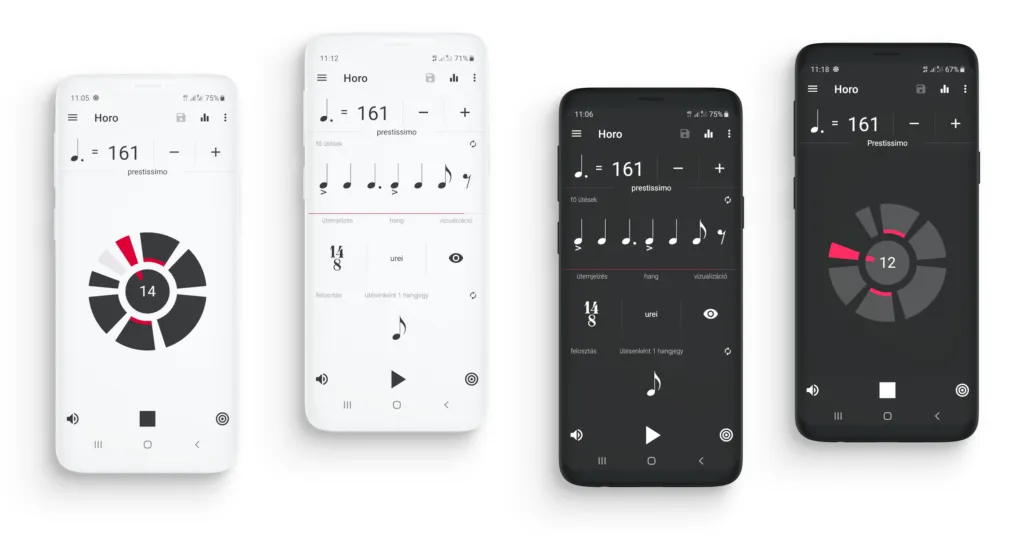
The mechanical metronome was invented in the 1810s. Today, besides an actual physical metronome, you can get a metronome right on your phone with one of the many free metronome apps.
Before you start the exercises, get yourself a metronome from Google or an app store. For Android I recommend metronome pro, and for Apple, for example, Pro metronome.
Exercise 1: Rhythm pyramid
Hopefully you now have a metronome installed. The goal of the first exercise is to make the timing of your basic notes as accurate as possible by playing different notes to the same pulse and switching between them without breaks.
Grab your sticks and your practice pad or sit down at your kit, and play the following exercise:
- 2 bars of quarter notes
- 2 bars of eighth notes
- 2 bars of sixteenth notes
Exercise 2: Gap click
A metronome gap click is a regular click track, except the metronome plays the pulse for a while and then goes silent for a set time. Your job is to keep the tempo steady during the silent part and land together with the metronome when it starts playing again.
Check out the two gap clicks below, one with a one-bar gap and one with a four-bar gap.
You can use the note pattern you just practiced in this exercise, or any pattern you like. A basic groove works too. You can practice any rudiment, groove or fill with a gap click. YouTube has click tracks for lots of different gaps and tempos. Try searching for something like "metronome gap click 100 bpm 4 bars".
Exercise 3: Live BPM
Live BPM is unfortunately a paid app, but I especially recommend it for improving your sense of time. Like the name says, Live BPM listens to your playing and tells you what tempo you're playing at. If you want to start a song at 120 BPM, you probably don't want the tempo to have dropped to 100 or climbed to 130 by the end of the song without you noticing.
With Live BPM you can play a gig without a click, so the playing can "flow" more freely. The app still shows you that the tempo isn't running off into those ranges, and you stay roughly at the agreed tempo.
Download Live BPM for Android or Apple.
Watch the video to see what playing with Live BPM looks like. The playing starts at the one-minute mark.
Bonus exercise: Record and film your playing
Finally, I have to mention that the best way to analyze your timing is to record yourself playing and then listen back for the parts that went well and the details that need work. Time problems, especially small slips on single notes, often aren't easy to notice while you're playing, so listening back afterwards may be the only way to catch the spots where your time isn't holding.
Filming helps a lot too, because besides hearing it, you can often see the moments where your time slips. Then you can focus on, for example, polishing your technique on a certain groove, so you get more relaxed playing and that way better time too.
So there were a few ways to improve a drummer's time and sense of time. I hope you find them helpful!