 Tasodrums

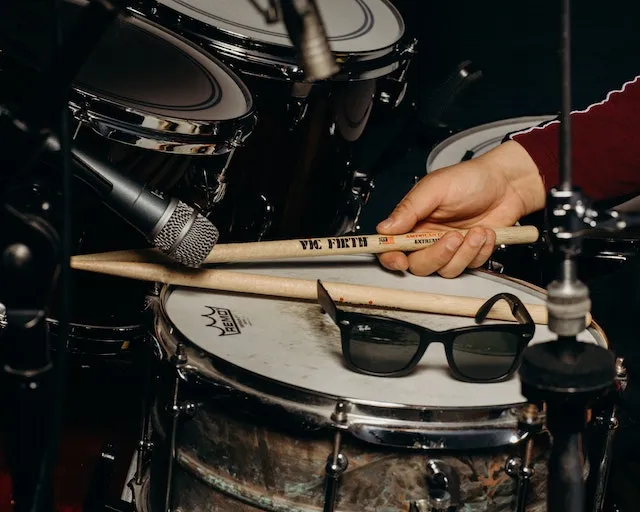
What are stickings and how are they different from drum notation
Stickings (sticking patterns) tell you how to play a certain note pattern by marking a specific limb for each note. Even though the word is sticking, it includes notes played with the feet too.
The difference from notation:
notation tells you which drum to play, stickings tell you which limb plays that note.
How stickings are written
Each limb has its own letter. The letters come from English words. In Finnish they're rarely translated, although of course you could.
- R = Right hand
- L = Left hand
- K = Kick - bass drum (right foot on a right-handed kit, like most people have)
- LF = Left foot - hi-hat pedal (left foot on a right-handed kit)
Most stickings only use R, L and K, but you do see the hi-hat pedal now and then too.
In Finnish, R L K would be O, V and B (oikea käsi, vasen käsi, bassorumpu), but as with drum terminology in general, Finns mostly use the English terms.
A bar without and with stickings
The bar below has half a bar of groove and a half-bar fill. Above the notes you can see how to count them, but since the sticking isn't marked, it's up to you to figure out the best way to play the fill.
Click the gray arrow to hear the bar played.
In the second bar, stickings have been added to the fill (the bass drum isn't always marked separately in notation). These help you see right away how the fill is meant to be played.
Why are stickings useful?
If you don't practice different stickings, usually one of two things happens:
1) All your fills are just alternating hands from one drum to the next, and it's hard to come up with new fills. The fills are monotonous and missing the variety the music needs.
2) You learn, say, 10 fills from a book and then play them exactly the same no matter the musical situation or context. Then the fills easily turn into pretty "mechanical" textbook versions, and they might not fit that spot at all.
So the benefit of stickings is that by combining different patterns you can create an unlimited number of starting points for fills. Your vocabulary grows, and you'll have something fitting to say in every musical situation.
Watch the video to see what fills played with stickings look like. Examples start at 2:50.
4 examples of the most popular stickings
Next, let's go through a few commonly used stickings with fill examples. Don't let their looks fool you. Even though these are very simple ideas, mastering them and combining them with new patterns already gives you countless different options.
1. R L K K
This is one of the cornerstones of metal music and metal fills, but it's used in other genres too, of course. Right, left, foot, foot.
2. R R L K
In this version the first two notes are played with the right hand, and with this simple trick you get to completely new rhythms.
3. R L L K
Let's split it a bit differently again, now the left hand plays two notes. Practice it with ghost notes too, so the left-hand notes are softer than the right-hand notes. Listen to the difference between the first and second bar.
4. R L K
Since there are three notes, this is usually played as triplets.
To stay with the same notes as in the earlier examples, meaning 16th notes, we can fill half a bar by playing R L K twice and then adding, for example, R L at the end. So R L K + R L K + R L.
How to get more out of stickings
In the examples you saw different stickings and what kinds of fills you can make with them. The best way to practice stickings is to pick one pattern and try as many different fills on the kit as you can think of.
Once you've got one pattern down, you can also combine patterns, like in the last example, and get even more ideas. These are generally called groupings. So you take, say, a 4-note sticking and add another sticking after it.
1. R L K K + R L R L
2. R R L K + R K R L
I hope this post gave you an idea of why learning and practicing stickings is useful and how you can get started learning new ones. The secret of these patterns is that the better a pattern is in your muscle memory, the faster you can play it, and that's how you get great-sounding fills.