 Tasodrums


What are rudiments?
Rudiments are stickings / patterns that help a drummer express themselves better on the snare drum or the drum kit. You could compare rudiments to scales on keyboard instruments.
Rudiments got their start in Europe during wars hundreds of years ago. The drummer's job was to use rudiments to send commands to the troops on the snare drum. The rhythm patterns had to be memorized and played while marching, so it made sense to develop certain short combinations. Rudiments made their way to the United States with the American Revolutionary War in 1775–1783.
As the drum kit and kit playing slowly developed, rudimental drumming moved over to the drum kit too. At the same time, new technology took drummers off the battlefield and into other jobs, like making sound effects for silent movies and working in the entertainment industry in general. Rudiments lived on in drumming and in drum teaching.
At some point along the way people started to want standards, because depending on the country and the teacher, everyone taught their students slightly different rudiments.
The first real list of "official" rudiments was put together by an association called N.A.R.D (National Association of Rudimental Drummers). The association was founded in 1933, and its first list had 13 "essential" rudiments. Another 13 were added later, and this list of 26 rudiments is still known as the "26 Standard American Drum Rudiments".
Later another association, called PAS (Percussive Arts Society), made a new list in 1984. This list has 40 rudiments. It includes basically the same rudiments as the N.A.R.D list, with 14 new ones added.
List of rudiments
Whichever list you use, rudiments can be divided into four categories:
- Roll Rudiments
- Diddle Rudiments
- Flam Rudiments
- Drag Rudiments
It doesn't really matter which list you start learning from, although the PAS list of 40 rudiments is maybe a bit more common and more widely used.
The most important rudiments for beginners
40 rudiments to learn sounds like quite a job. The good news is that a few of the most essential rudiments will get you off to a good start:
- Single Stroke Roll
- Double Stroke Roll
- Paradiddle
- Flam
- Drag
- Multiple Bounce Roll (Buzz Roll)
These rudiments are the foundation for all forty rudiments, so don't move on until you have the basics of these down.
Watch all the rudiments in order in this video, or go to YouTube, where you can easily watch just these rudiments from a playlist and practice along.
N.A.R.D Finland - The first chapter
There's rudimental drumming in Finland too: Finland was the first country to open an official N.A.R.D chapter, in 2018. You can find N.A.R.D Finland on Facebook, where you can watch a livestream about rudimental drumming recorded in spring 2020.
It's worth following what N.A.R.D Finland is up to anyway if you're interested in rudimental drumming. One of their members has also started a drum group, so you can join that too, at least in the Helsinki area.
Of course, we also have the Finnish Defence Forces Conscript Band. The band is put together from the January intake and performs actively all year round. So if your skills and age let you apply to the conscript band, what nicer way could there be to do your military service?
How to practice rudiments?
You're not done studying a rudiment when you can play it on a practice pad at 60 BPM. Watch the video to see everything you can do with rudiments, and find instructions for studying rudiments below the video.

1. Sticking, feel and accents
Let's take the Paradiddle as an example
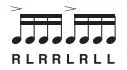
R = right hand, L = left hand. The little wedge above a note means an accent, which is a stronger stroke. In this rudiment you accent the note where the leading hand switches.
Feel: the rudiment is felt as 16th notes
1 e & a 2 e & a 3 e & a 4 e & a
Sticking: R L R R L R L L

2. Practice on a practice pad or snare
Download a metronome app. Start at, say, 60 BPM. Learn the rudiment slowly and raise the tempo little by little. A good goal could be something like 100-120 BPM, so it starts to be useful in music.
In rudimental drumming, a rudiment is often played by starting slow, speeding up little by little toward your maximum, and then slowing back down again.

Take the rudiment to the drum kit
Once you've learned the sticking, picked up some speed and can stay in time with the metronome, it's time to try out what you could use the rudiment for. As a groove, a fill, or part of one of these? Check out ways to use the paradiddle in the "Paradiddle Applications" video below.